Publications
2026
-
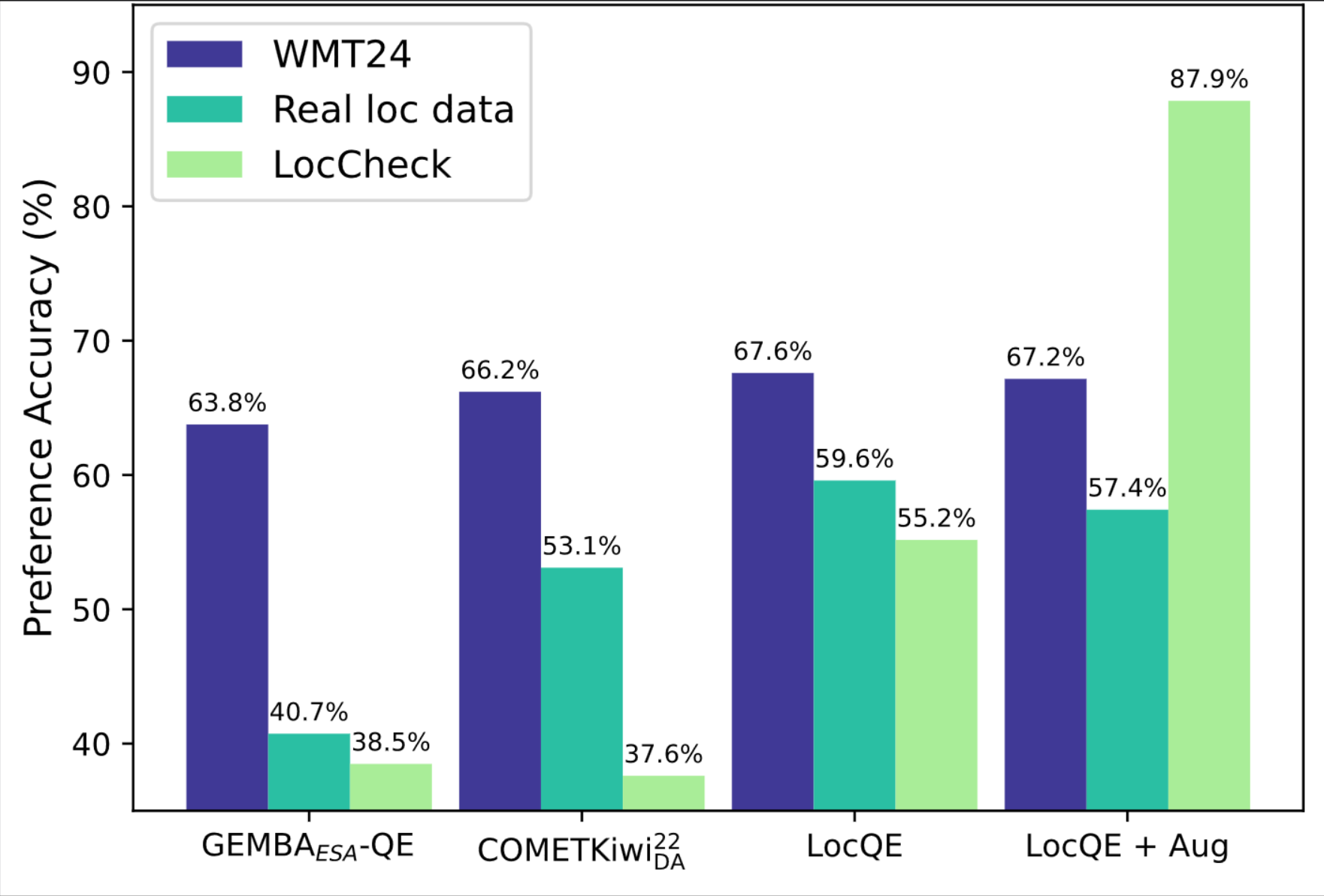 LocQE: Principled Domain Adaptation for Localisation Quality Estimation by Leveraging Post-EditsKathy Hämmerl, Gabriel Bretschner, and Joern WuebkerIn Proceedings of the Eleventh Conference on Machine Translation, Oct 2026
Learned quality estimation (QE) models such as COMETKiwi are widespread and work well for general machine translation evaluation. However, they are known to struggle on unseen domains, limiting their performance in a real-world localisation context. We show that they are insensitive to some important factors in localisation, such as whether numbers are translated accurately, or even whether the correct number of spaces and punctuation are preserved in a translation. Further, a key capability for optimisation of machine translation is the ability of QE models to accurately rank different translations of a single segment, which suffers significantly from the domain transfer. In the absence of large-scale direct assessment data, we propose principled fine-tuning approaches to reduce the domain gap with even small amounts of post-editing data. Using a multi-task fine-tuning approach and a simple tokeniser intervention, we create a QE model which proves markedly better at distinguishing preferred post-edits from rejected initial translations in a localisation context. We show that preferences and artificial continuous scores stabilise each other, and argue that to calibrate metrics both in terms of their absolute scores and comparisons between translation of the same source, both types of signal are needed
@inproceedings{haemmerl-etal-2026-locqe, title = {LocQE: Principled Domain Adaptation for Localisation Quality Estimation by Leveraging Post-Edits}, author = {H{\"a}mmerl, Kathy and Bretschner, Gabriel and Wuebker, Joern}, booktitle = {Proceedings of the Eleventh Conference on Machine Translation}, month = oct, year = {2026}, address = {Budapest, Hungary}, publisher = {Association for Computational Linguistics}, } -
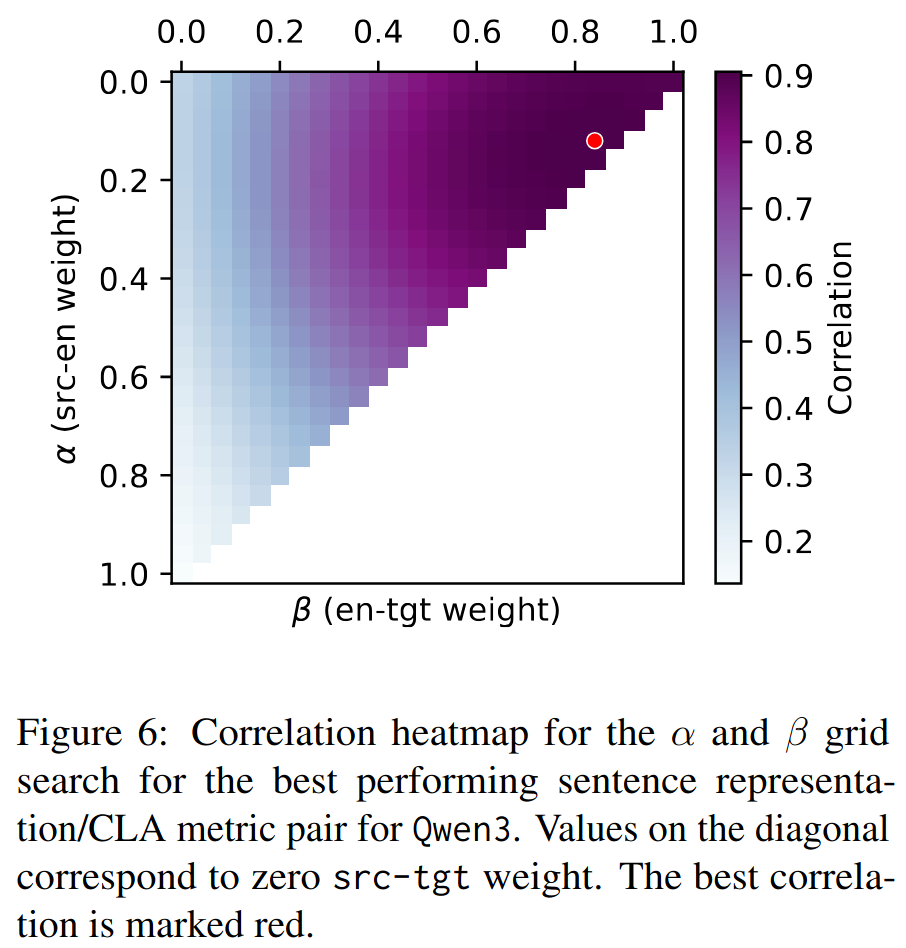 Predicting Multilingual Classification and Translation Performance of LLMs with Cross-Lingual Alignment—Is English Enough?Adnan Al Ali, Kathy Hämmerl, Jindřich Libovický, and Alexander Fraser2026
Multilingual large language models (LLMs) have been shown to perform better on non-English classification tasks when the representations of the given language are more aligned to English within the model. Several cross-lingual alignment (CLA) scores have been proposed for use with LLMs, along with multiple approaches for extracting embeddings from the models. We provide a comparative analysis of 27 CLA score variants, examining how they differ and how well each predicts downstream performance across three tasks. Crucially, while LLMs are widely used for generative tasks such as machine translation, prior work has focused almost exclusively on classification. We therefore investigate whether CLA scores are similarly predictive of translation performance. To enable computing correlations across target languages, we propose a PMI-based translation metric, which is less dependent on the target language and correlates strongly with chrF. We find that CLA with English predicts translation quality comparably to or better than source-target CLA, providing new evidence that LLMs use English as an internal pivot language.
@misc{ali2026predictingmultilingualclassificationtranslation, title = {Predicting Multilingual Classification and Translation Performance of LLMs with Cross-Lingual Alignment---Is English Enough?}, author = {Ali, Adnan Al and H{\"a}mmerl, Kathy and Libovick{\'y}, Jind{\v{r}}ich and Fraser, Alexander}, year = {2026}, archiveprefix = {arXiv}, primaryclass = {cs.CL}, url = {https://arxiv.org/abs/2608.03446}, } -
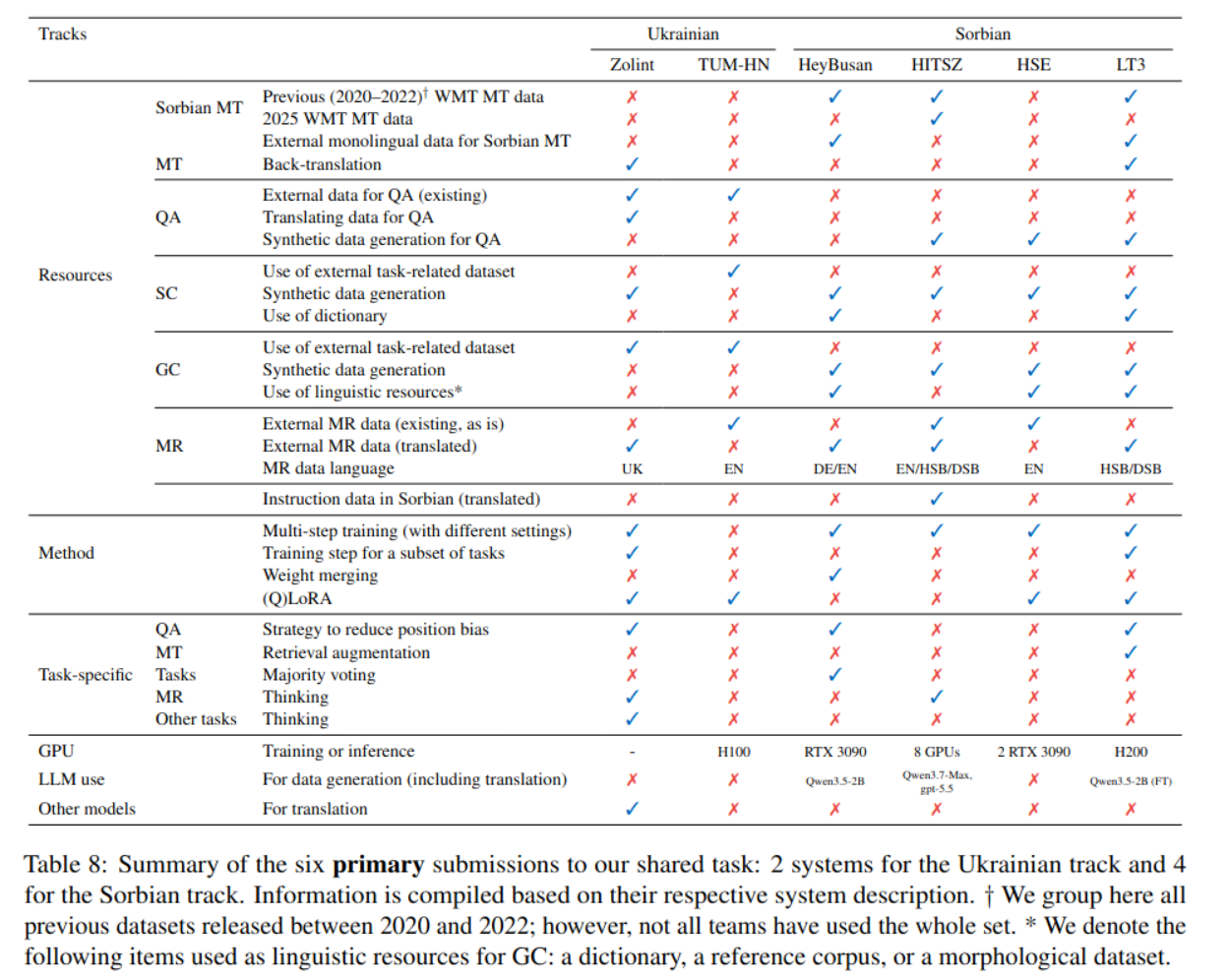 Findings of the WMT26 Shared Task: Multitask LLMs with Limited ResourcesShu Okabe, Marion Di Marco, Kathy Hämmerl, Daryna Dementieva, Lukas Edman, Marko Měškank, Anita Hendrichowa, and Alexander FraserIn Proceedings of the Eleventh Conference on Machine Translation, Oct 2026
We present the Findings of the WMT 2026 Shared Task on Multitask LLMs with Limited Resources. This year, we extended the Shared Task to jointly model five diverse NLP tasks, Machine Translation (MT) for five language pairs (eight directions), Question Answering (QA), Spell Checking (SC), Grammar Checking (GC), and Mathematical Reasoning (MR), for two language tracks: Ukrainian and Sorbian (grouping Upper and Lower Sorbian). As the Shared Task is focused on low-resource conditions, the model is restricted to Qwen3.5-2B to remain below the 3B-parameter threshold.\n\nIn total, six teams participated across the two language tracks: two in the Ukrainian and four in the Sorbian track. No team participated in both language tracks. All systems have been uploaded to HuggingFace by the participants. Despite our strict restrictions on model and dataset availability, systems were diverse in the resources they used as well as their training and inference strategies. The submitted systems show that a single small model can handle all five tasks, with clear difficulty shown for the challenging MR only.
@inproceedings{okabe-etal-2026-findings, title = {{Findings of the WMT26 Shared Task: Multitask LLMs with Limited Resources}}, author = {Okabe, Shu and Di Marco, Marion and H{\"a}mmerl, Kathy and Dementieva, Daryna and Edman, Lukas and M{\v{e}}{\v{s}}kank, Marko and Hendrichowa, Anita and Fraser, Alexander}, booktitle = {Proceedings of the Eleventh Conference on Machine Translation}, month = oct, year = {2026}, address = {Budapest, Hungary}, publisher = {Association for Computational Linguistics}, } -
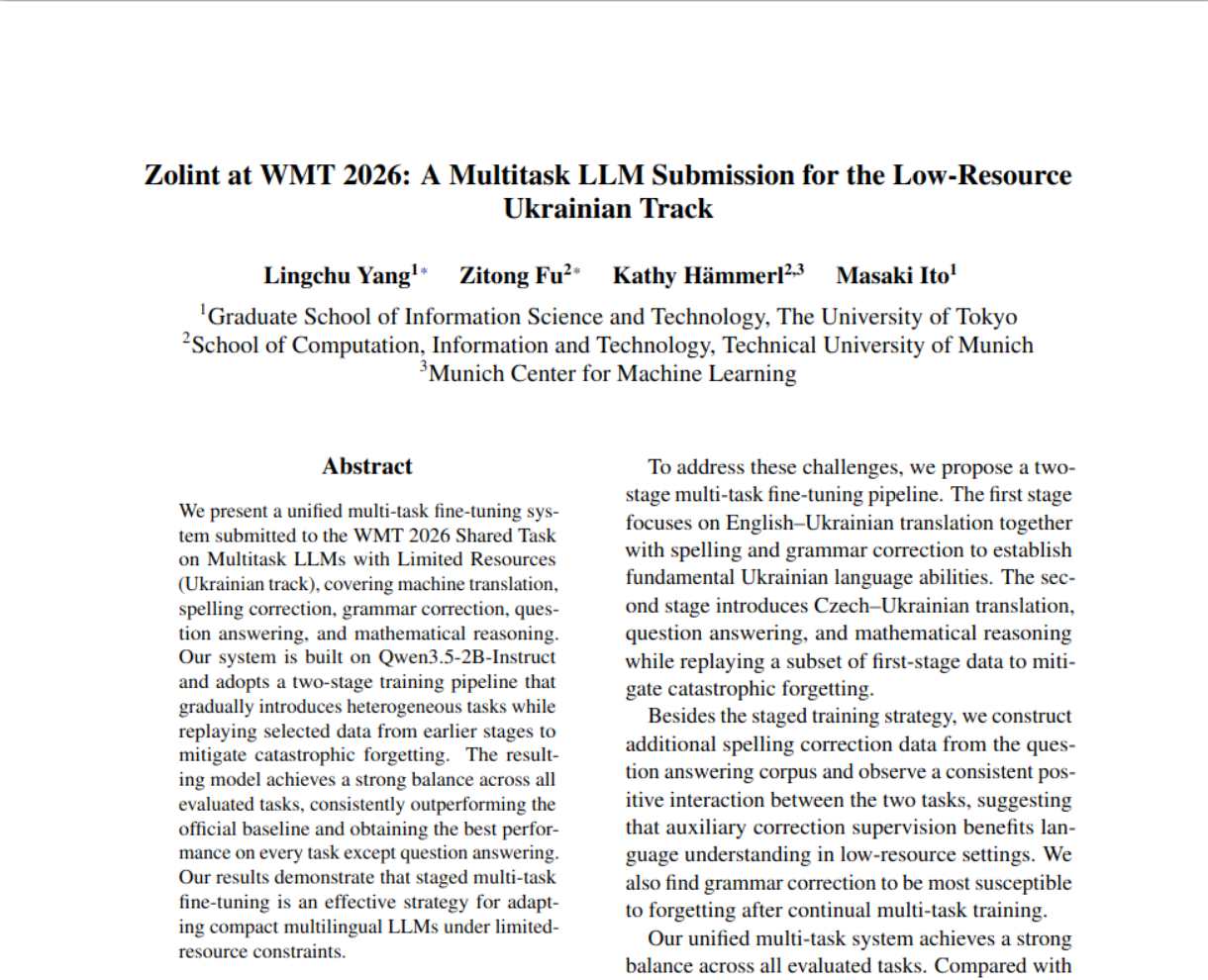 Zolint at WMT 2026: A Multitask LLM Submission for the Low-Resource Ukrainian TrackLingchu Yang, Zitong Fu, Kathy Hämmerl, and Masaki ItoIn Proceedings of the Eleventh Conference on Machine Translation, Oct 2026
We present a unified multi-task fine-tuning system submitted to the WMT 2026 Shared Task on Multitask LLMs with Limited Resources (Ukrainian track), covering machine translation, spelling correction, grammar correction, question answering, and mathematical reasoning. Our system is built on Qwen3.5-2B-Instruct and adopts a two-stage training pipeline that gradually introduces heterogeneous tasks while replaying selected data from earlier stages to mitigate catastrophic forgetting. The resulting model achieves a strong balance across all evaluated tasks, consistently outperforming the official baseline and obtaining the best performance on every task except question answering. Our results demonstrate that staged multi-task fine-tuning is an effective strategy for adapting compact multilingual LLMs under limited-resource constraints.
@inproceedings{zolint-2026, author = {Yang, Lingchu and Fu, Zitong and H{\"a}mmerl, Kathy and Ito, Masaki}, title = {Zolint at WMT 2026: A Multitask LLM Submission for the Low-Resource Ukrainian Track}, booktitle = {Proceedings of the Eleventh Conference on Machine Translation}, month = oct, year = {2026}, address = {Budapest, Hungary}, publisher = {Association for Computational Linguistics}, } -
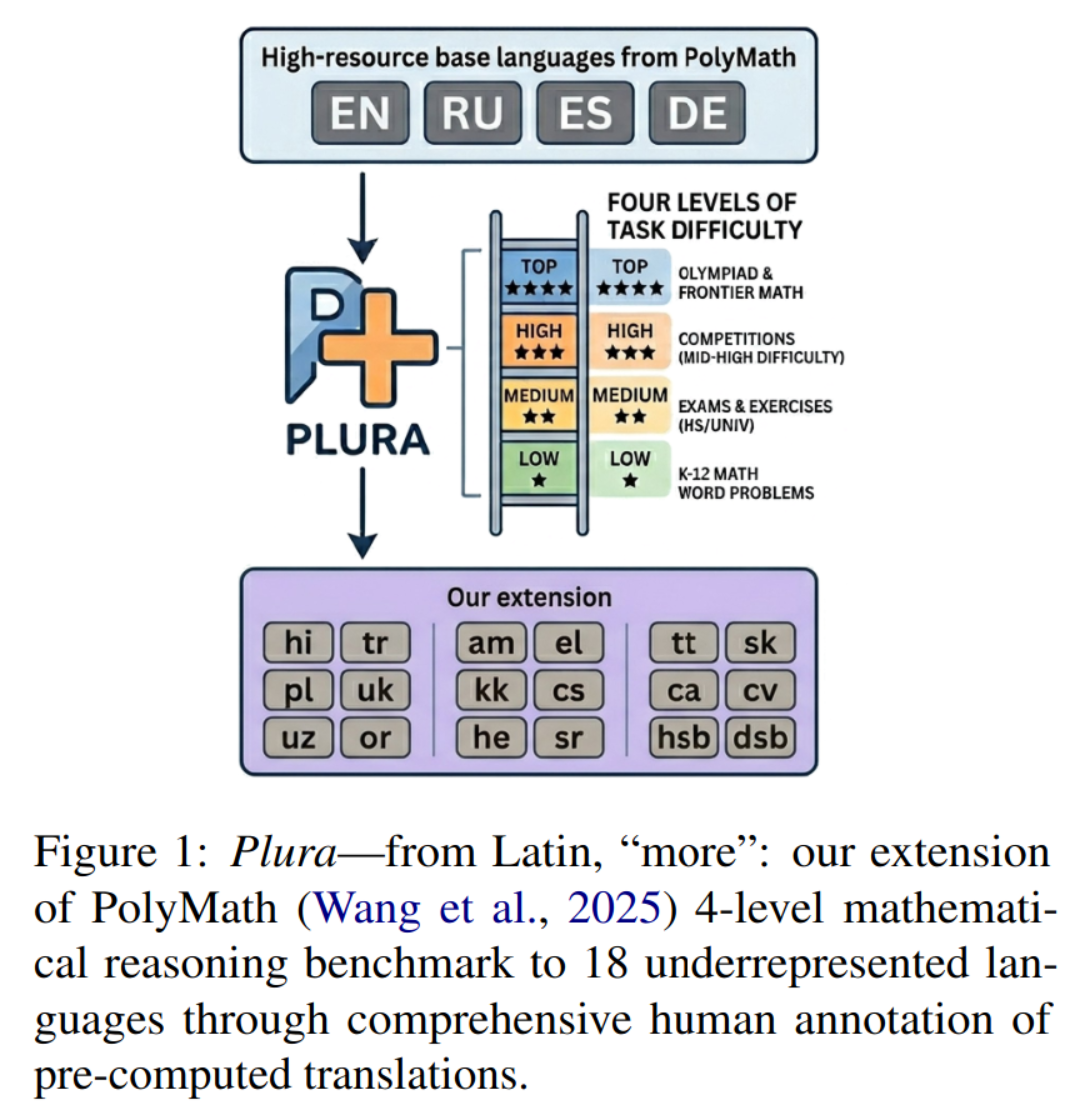 PluraMath: Extending Mathematical Reasoning Evaluation Beyond High-Resource LanguagesDaryna Dementieva, Nikolay Babakov, Kathy Hämmerl, Ilseyar Alimova, Jindřich Libovický, Shu Okabe, Miras Baisbay, Lukas Edman, Abrorkhon Inomkhujaev, Antonia Karamolegkou, and 7 more authors2026
Mathematical reasoning has become a central task for evaluating and tuning reasoning Large Language Models (LLMs), yet existing benchmarks remain heavily biased toward high-resource languages, with English and Chinese dominating both pre-training corpora and evaluation suites. The recently released PolyMath (Wang et al., 2025) dataset represents a significant step forward, yet its coverage is still limited to 18 only high-resource languages. To address this gap, we introduce PluraMath, an extension of PolyMath to 18 additional underrepresented languages spanning 6 language families – ranging from mid-resource to extreme low-resource settings. We constructed the dataset through a human-curated pipeline, where native speakers thoroughly validated pre-computed translations. Using PluraMath, we then benchmark 27 reasoning LLMs across four model scales – small, mid-size, large, and closed-source ensembles – probing the multilingual mathematical reasoning capabilities of state-of-the-art models under diverse linguistic conditions. Our fine-grained analysis confirms a persistent gap in mathematical reasoning performance between high-resource and underrepresented languages, with stronger results largely associated with better instruction-following ability. We fully open-source our dataset, data acquisition pipeline, and evaluation framework, with the goal of lowering the barrier to multilingual benchmark development for underrepresented communities.
@misc{dementieva2026pluramathextendingmathematicalreasoning, title = {PluraMath: Extending Mathematical Reasoning Evaluation Beyond High-Resource Languages}, author = {Dementieva, Daryna and Babakov, Nikolay and H{\"a}mmerl, Kathy and Alimova, Ilseyar and Libovick{\'y}, Jind{\v{r}}ich and Okabe, Shu and Baisbay, Miras and Edman, Lukas and Inomkhujaev, Abrorkhon and Karamolegkou, Antonia and Lango, Mateusz and {\"O}zer, Volkan and Selic, Nikola and Swain, Subhankar and Temesgen, Tsedeniya Kinfe and Weisberg, Galit Bary and Fraser, Alexander}, year = {2026}, archiveprefix = {arXiv}, primaryclass = {cs.CL}, url = {https://arxiv.org/abs/2607.05992}, } -
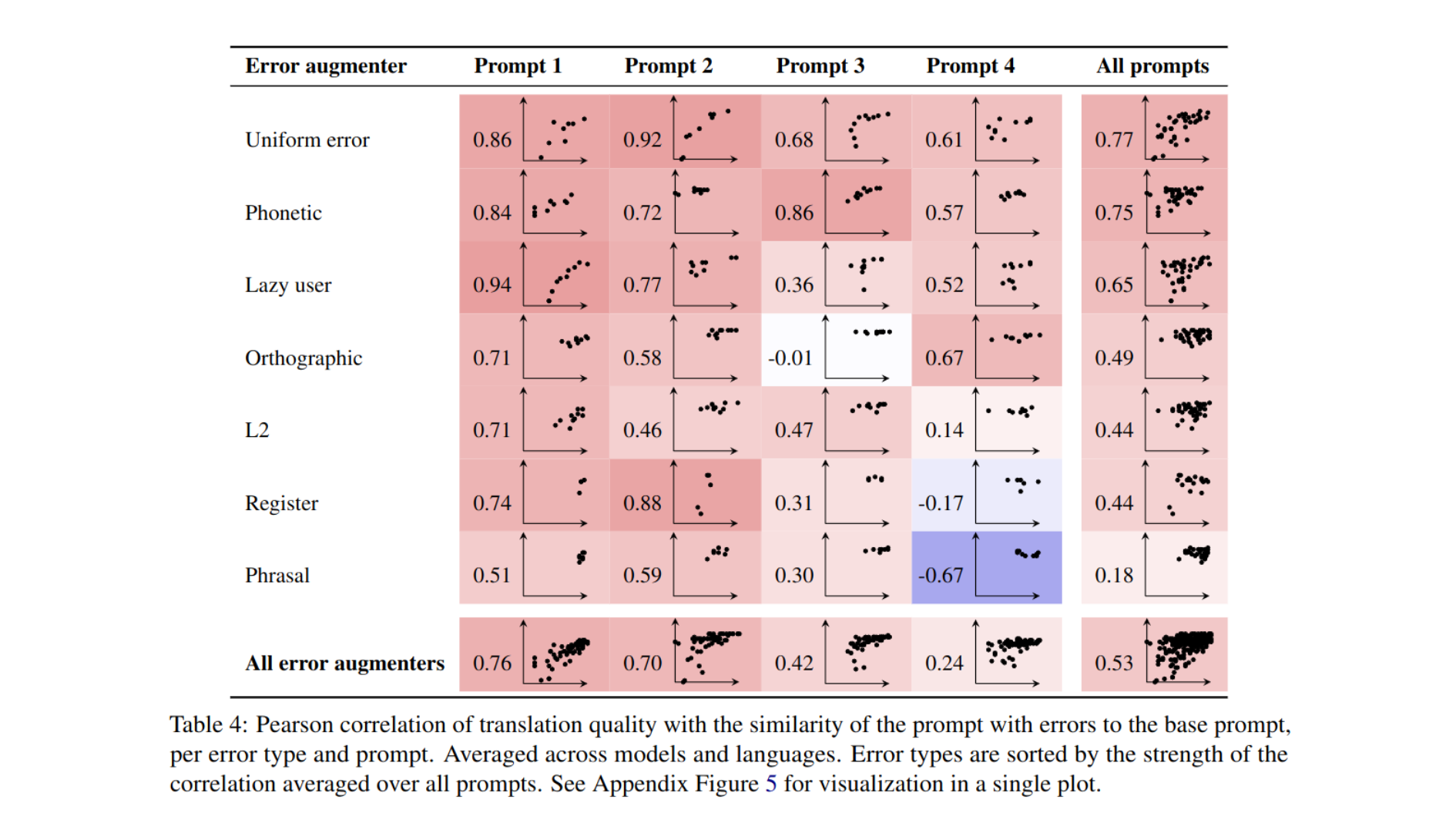 How Important is ‘Perfect’ English for Machine Translation Prompts?Patrícia Schmidtová, Niyati Bafna, Seth Aycock, Gianluca Vico, Wiktor Kamzela, Kathy Hämmerl, and Vilém ZouharIn Findings of the Association for Computational Linguistics: EACL 2026, Mar 2026
Large language models (LLMs) show state-of-the-art performance in machine translation, but are also known to be sensitive to errors in user prompts. Given these models are largely trained on and respond best to prompts in standard English, this may affect the quality of LLM outputs for second language English speakers as well as real-world lay users, with potentially disproportionate effects on the former. We explore this effect by modeling a range of error types exhibited by such users, motivated by studies of L2 English, and quantifying their impact on LLM performance. We work with two related tasks: machine translation and machine translation evaluation. We find that LLMs-as-MT are brittle to natural spelling errors but not to errors at the phrasal level. However, the variance in quality caused by these errors is lower than the variance over the initial prompt choice, suggesting that “perfect English” for a given prompt is less important than choosing a good prompt. Since lay users and L2 speakers may use non-optimal prompts as well as display imperfect language skills, our work calls for increasing the resilience of model performance to both these phenomena to best serve a diverse user base, both from a robustness and fairness perspective.
@inproceedings{schmidtova-etal-2026-important,
  title = {How Important is `Perfect' {E}nglish for Machine Translation Prompts?},
  author = {Schmidtov{\'a}, Patr{\'i}cia and Bafna, Niyati and Aycock, Seth and Vico, Gianluca and Kamzela, Wiktor and H{\"a}mmerl, Kathy and Zouhar, Vil{\'e}m},
  editor = {Demberg, Vera and Inui, Kentaro and Marquez, Llu{\'i}s},
  booktitle = {Findings of the {A}ssociation for {C}omputational {L}inguistics: {EACL} 2026},
  month = mar,
  year = {2026},
  address = {Rabat, Morocco},
  publisher = {Association for Computational Linguistics},
  url = {https://aclanthology.org/2026.findings-eacl.38/},
  doi = {10.18653/v1/2026.findings-eacl.38},
  pages = {760--777},
  isbn = {979-8-89176-386-9},
}
2025
-
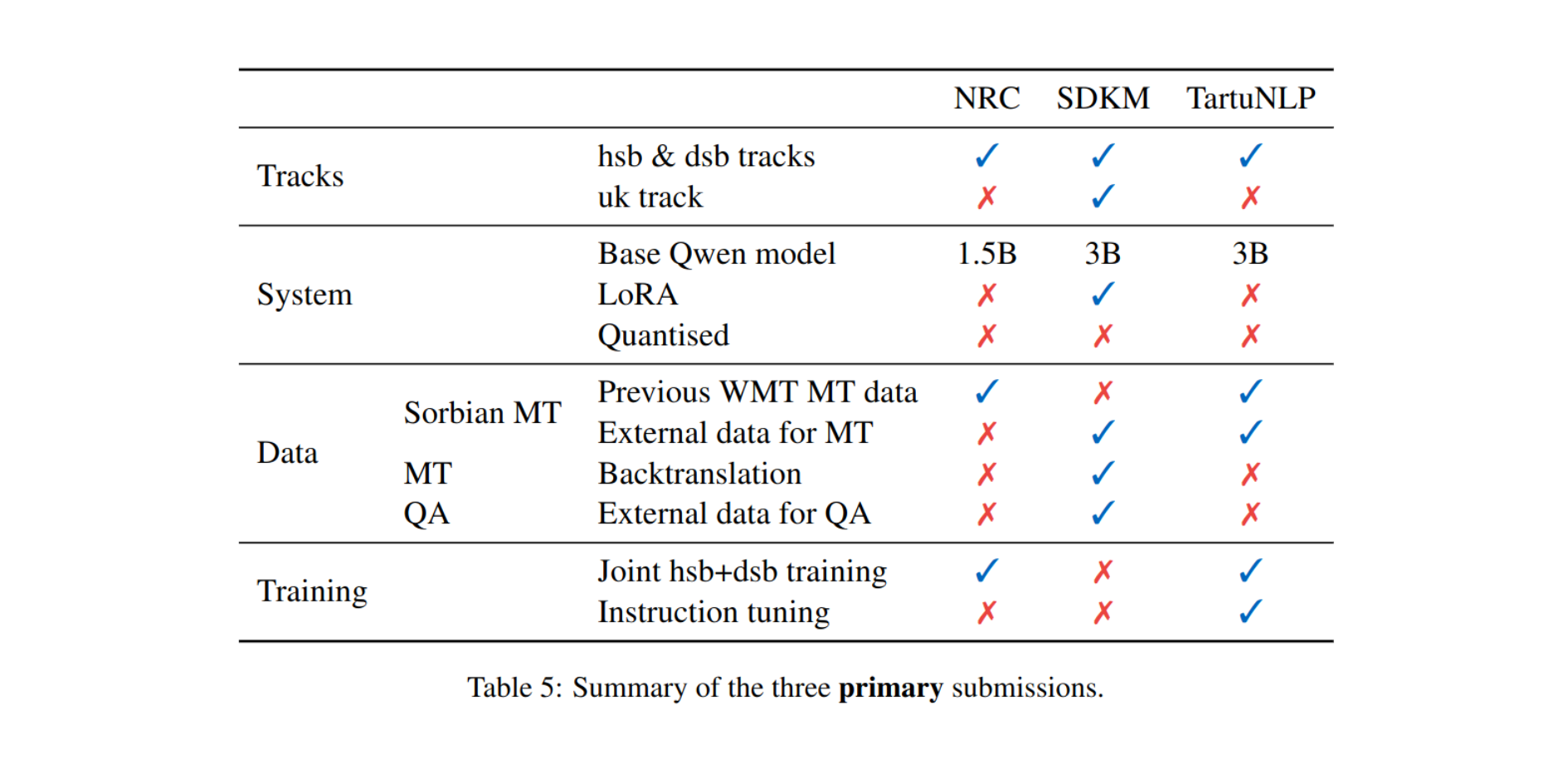 Findings of the WMT 2025 Shared Task LLMs with Limited Resources for Slavic Languages: MT and QAShu Okabe, Daryna Dementieva, Marion Di Marco, Lukas Edman, Kathy Hämmerl, Marko Měškank, Anita Hendrichowa, and Alexander FraserIn Proceedings of the Tenth Conference on Machine Translation, Nov 2025
We present the findings of the WMT 2025 Shared Task LLMs with Limited Resources for Slavic Languages. This shared task focuses on training LLMs using limited data and compute resources for three Slavic languages: Upper Sorbian (hsb), Lower Sorbian (dsb), and Ukrainian (uk), with the objective to develop and improve LLMs for these languages. We consider two tasks which are to be evaluated jointly: Machine Translation (MT) and Multiple-Choice Question Answering (QA). In total, three teams participated in this shared task, with submissions from all three teams for the Sorbian languages and one submission for Ukrainian. All submissions led to an improvement compared to the baseline Qwen2.5-3B model through varying fine-tuning strategies. We note, however, that training purely on MT degrades original QA capabilities. We also report further analyses on the submissions, including MT evaluation using advanced neural metrics for Ukrainian, as well as manual annotation and comparison to the current Sorbian machine translator.
@inproceedings{okabe-etal-2025-findings, title = {Findings of the {WMT} 2025 Shared Task {LLM}s with Limited Resources for {S}lavic Languages: {MT} and {QA}}, author = {Okabe, Shu and Dementieva, Daryna and Di Marco, Marion and Edman, Lukas and H{\"a}mmerl, Kathy and M{\v{e}}{\v{s}}kank, Marko and Hendrichowa, Anita and Fraser, Alexander}, editor = {Haddow, Barry and Kocmi, Tom and Koehn, Philipp and Monz, Christof}, booktitle = {Proceedings of the Tenth Conference on Machine Translation}, month = nov, year = {2025}, address = {Suzhou, China}, publisher = {Association for Computational Linguistics}, url = {https://aclanthology.org/2025.wmt-1.27/}, doi = {10.18653/v1/2025.wmt-1.27}, pages = {503--519}, isbn = {979-8-89176-341-8}, } -
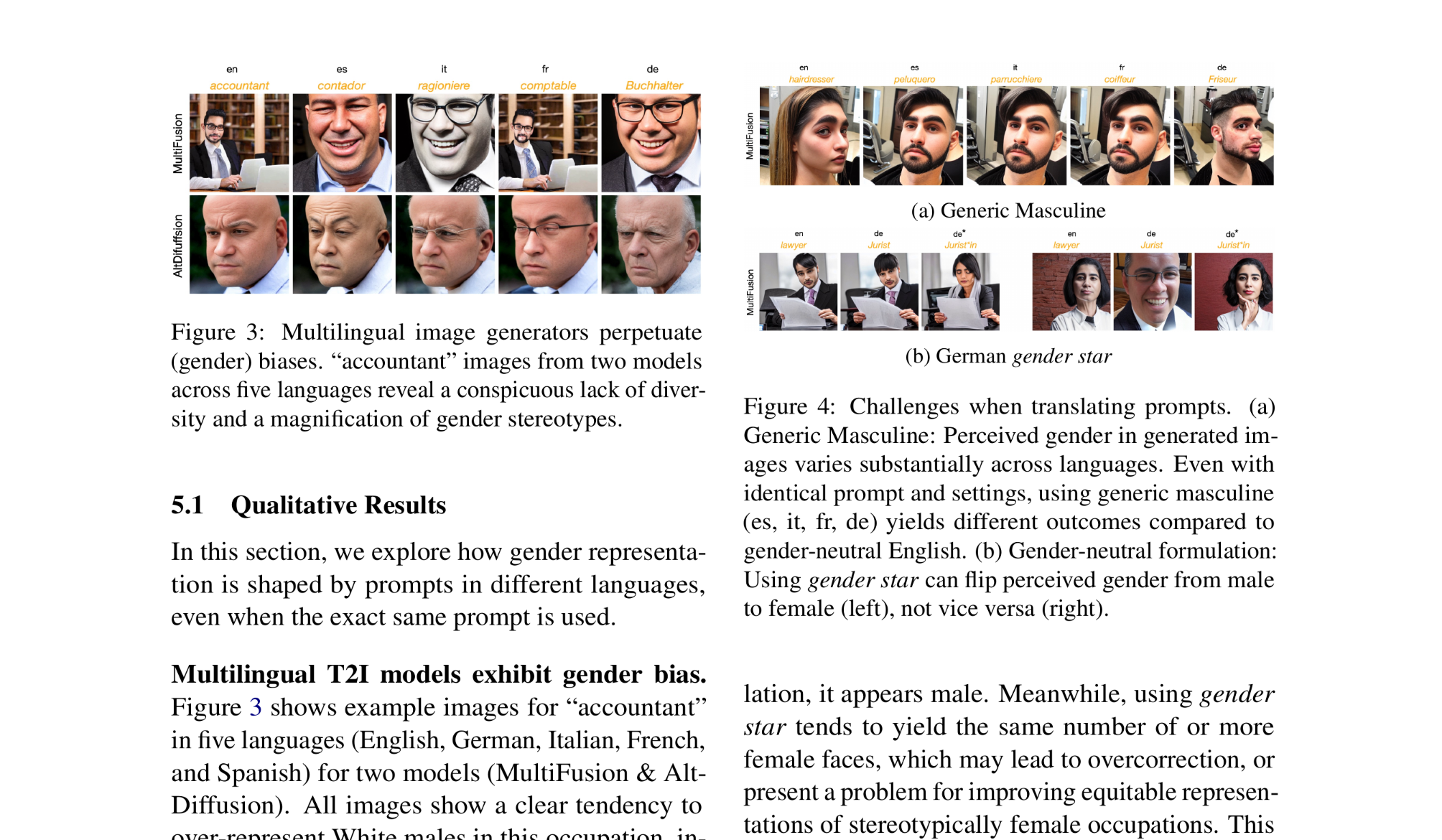 Multilingual Text-to-Image Generation Magnifies Gender StereotypesFelix Friedrich, Kathy Hämmerl, Patrick Schramowski, Manuel Brack, Jindřich Libovický, Kristian Kersting, and Alexander FraserIn Proceedings of the 63rd Annual Meeting of the Association for Computational Linguistics (Volume 1: Long Papers), Jul 2025
Text-to-image (T2I) generation models have achieved great results in image quality, flexibility, and text alignment, leading to widespread use. Through improvements in multilingual abilities, a larger community can access this technology. Yet, we show that multilingual models suffer from substantial gender bias. Furthermore, the expectation that results should be similar across languages does not hold. We introduce MAGBIG, a controlled benchmark designed to study gender bias in multilingual T2I models, and use it to assess the impact of multilingualism on gender bias. To this end, we construct a set of multilingual prompts that offers a carefully controlled setting accounting for the complex grammatical differences influencing gender across languages. Our results show strong gender biases and notable language-specific differences across models. While we explore prompt engineering strategies to mitigate these biases, we find them largely ineffective and sometimes even detrimental to text-to-image alignment. Our analysis highlights the need for research on diverse language representations and greater control over bias in T2I models.
@inproceedings{friedrich-etal-2025-multilingual, title = {Multilingual Text-to-Image Generation Magnifies Gender Stereotypes}, author = {Friedrich, Felix and H{\"a}mmerl, Kathy and Schramowski, Patrick and Brack, Manuel and Libovick{\'y}, Jind{\v{r}}ich and Kersting, Kristian and Fraser, Alexander}, editor = {Che, Wanxiang and Nabende, Joyce and Shutova, Ekaterina and Pilehvar, Mohammad Taher}, booktitle = {Proceedings of the 63rd Annual Meeting of the Association for Computational Linguistics (Volume 1: Long Papers)}, month = jul, year = {2025}, address = {Vienna, Austria}, publisher = {Association for Computational Linguistics}, url = {https://aclanthology.org/2025.acl-long.966/}, doi = {10.18653/v1/2025.acl-long.966}, pages = {19656--19679}, isbn = {979-8-89176-251-0}, } -
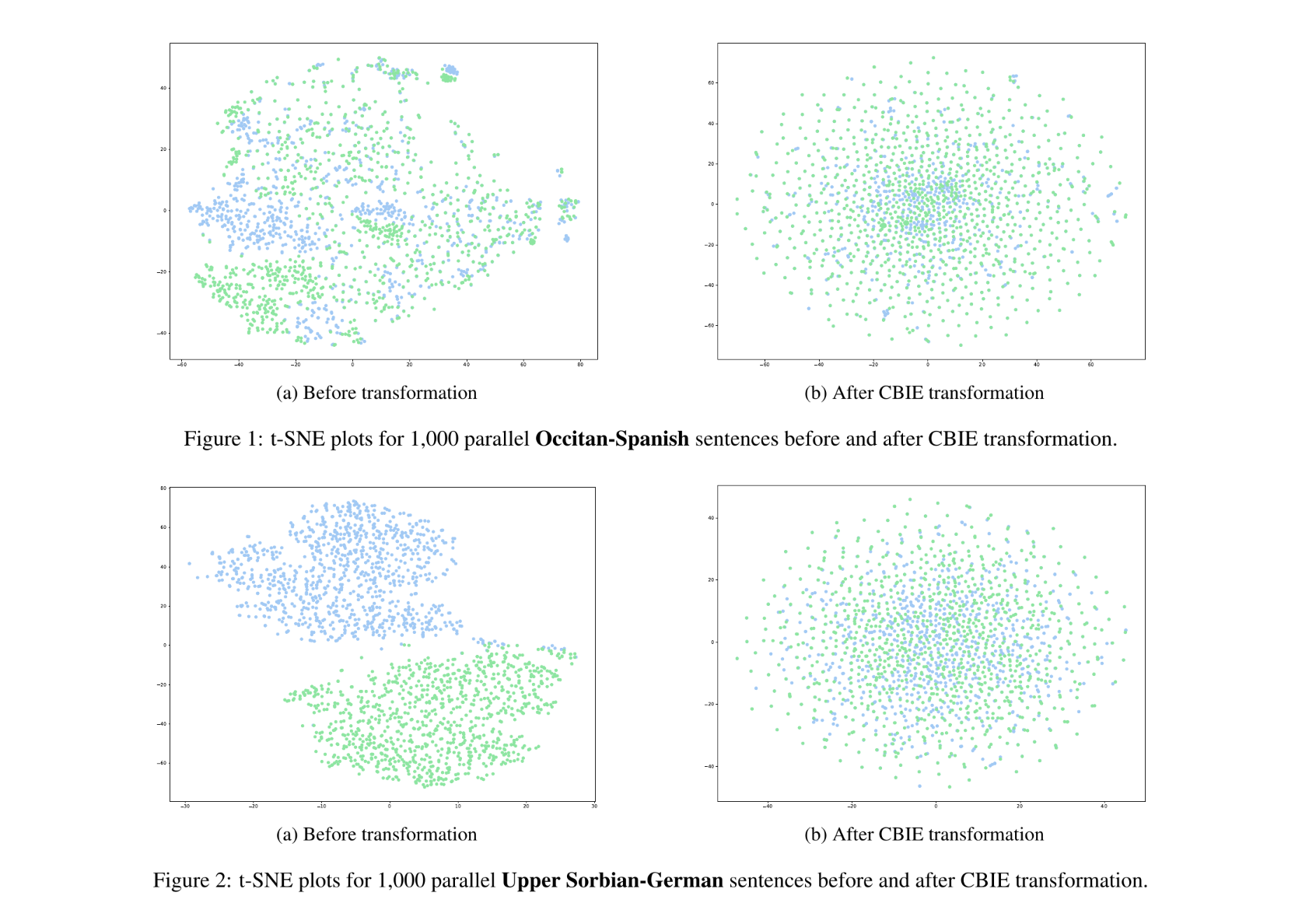 Improving Parallel Sentence Mining for Low-Resource and Endangered LanguagesShu Okabe, Kathy Hämmerl, and Alexander FraserIn Proceedings of the 63rd Annual Meeting of the Association for Computational Linguistics (Volume 2: Short Papers), Jul 2025
While parallel sentence mining has been extensively covered for fairly well-resourced languages, pairs involving low-resource languages have received comparatively little attention.To address this gap, we present Belopsem, a benchmark of new datasets for parallel sentence mining on three language pairs where the source side is low-resource and endangered: Occitan-Spanish, Upper Sorbian-German, and Chuvash-Russian. These combinations also reflect varying linguistic similarity within each pair. We compare three language models in an established parallel sentence mining pipeline and apply two types of improvements to one of them, Glot500. We observe better mining quality overall by both applying alignment post-processing with an unsupervised aligner and using a cluster-based isotropy enhancement technique. These findings are crucial for optimising parallel data extraction for low-resource languages in a realistic way.
@inproceedings{okabe-etal-2025-improving, title = {Improving Parallel Sentence Mining for Low-Resource and Endangered Languages}, author = {Okabe, Shu and H{\"a}mmerl, Kathy and Fraser, Alexander}, editor = {Che, Wanxiang and Nabende, Joyce and Shutova, Ekaterina and Pilehvar, Mohammad Taher}, booktitle = {Proceedings of the 63rd Annual Meeting of the Association for Computational Linguistics (Volume 2: Short Papers)}, month = jul, year = {2025}, address = {Vienna, Austria}, publisher = {Association for Computational Linguistics}, url = {https://aclanthology.org/2025.acl-short.17/}, doi = {10.18653/v1/2025.acl-short.17}, pages = {196--205}, isbn = {979-8-89176-252-7}, } -
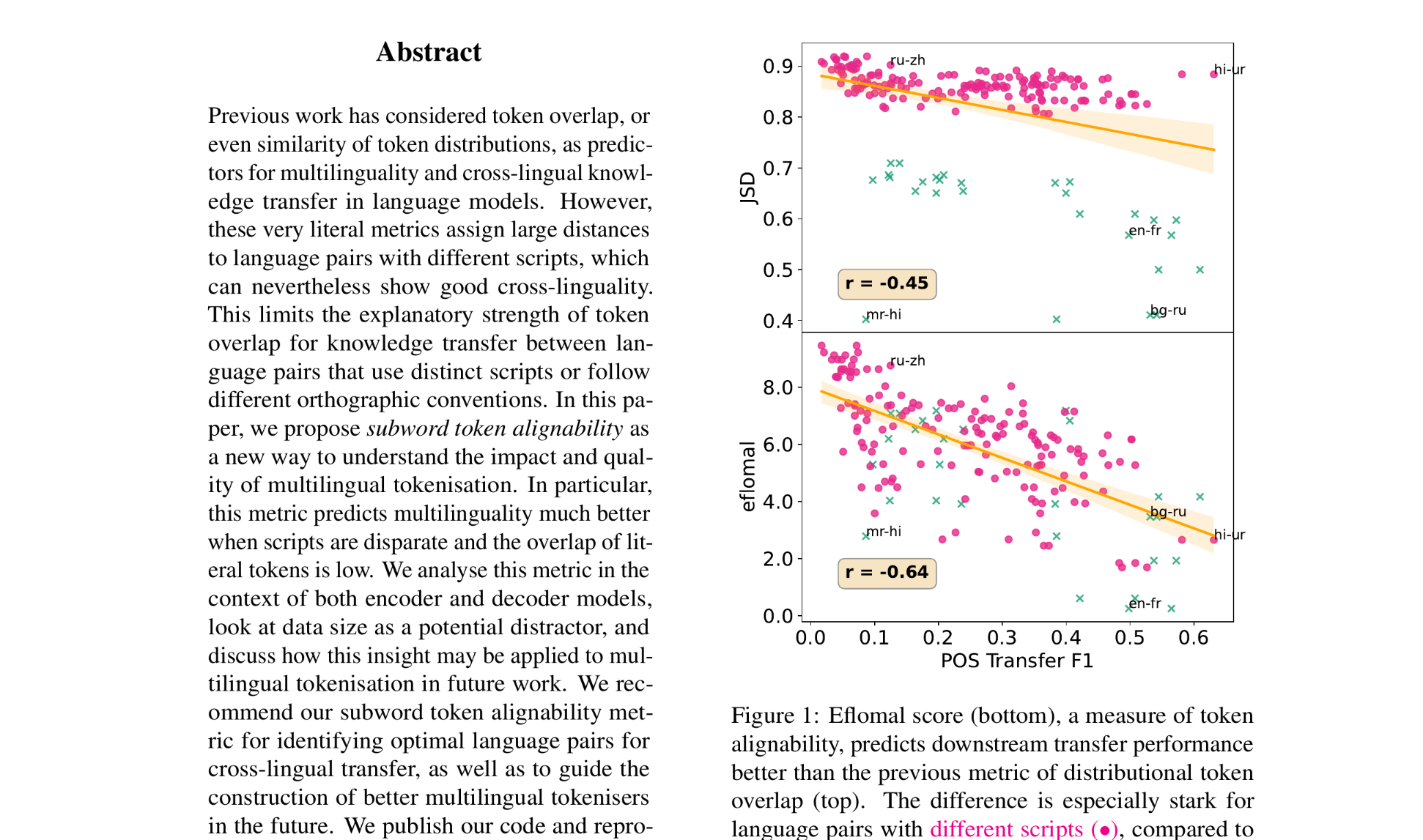 Beyond Literal Token Overlap: Token Alignability for MultilingualityIn Proceedings of the 2025 Conference of the Nations of the Americas Chapter of the Association for Computational Linguistics: Human Language Technologies (Volume 2: Short Papers), Apr 2025
Previous work has considered token overlap, or even similarity of token distributions, as predictors for multilinguality and cross-lingual knowledge transfer in language models. However, these very literal metrics assign large distances to language pairs with different scripts, which can nevertheless show good cross-linguality. This limits the explanatory strength of token overlap for knowledge transfer between language pairs that use distinct scripts or follow different orthographic conventions. In this paper, we propose subword token alignability as a new way to understand the impact and quality of multilingual tokenisation. In particular, this metric predicts multilinguality much better when scripts are disparate and the overlap of literal tokens is low. We analyse this metric in the context of both encoder and decoder models, look at data size as a potential distractor, and discuss how this insight may be applied to multilingual tokenisation in future work. We recommend our subword token alignability metric for identifying optimal language pairs for cross-lingual transfer, as well as to guide the construction of better multilingual tokenisers in the future. We publish our code and reproducibility details.
@inproceedings{hammerl-etal-2025-beyond,
  title = {Beyond Literal Token Overlap: Token Alignability for Multilinguality},
  author = {H{\"a}mmerl, Kathy and Limisiewicz, Tomasz and Libovick{\'y}, Jind{\v{r}}ich and Fraser, Alexander},
  editor = {Chiruzzo, Luis and Ritter, Alan and Wang, Lu},
  booktitle = {Proceedings of the 2025 Conference of the Nations of the Americas Chapter of the Association for Computational Linguistics: Human Language Technologies (Volume 2: Short Papers)},
  month = apr,
  year = {2025},
  address = {Albuquerque, New Mexico},
  publisher = {Association for Computational Linguistics},
  url = {https://aclanthology.org/2025.naacl-short.63/},
  doi = {10.18653/v1/2025.naacl-short.63},
  pages = {756--767},
  isbn = {979-8-89176-190-2},
}
2024
-
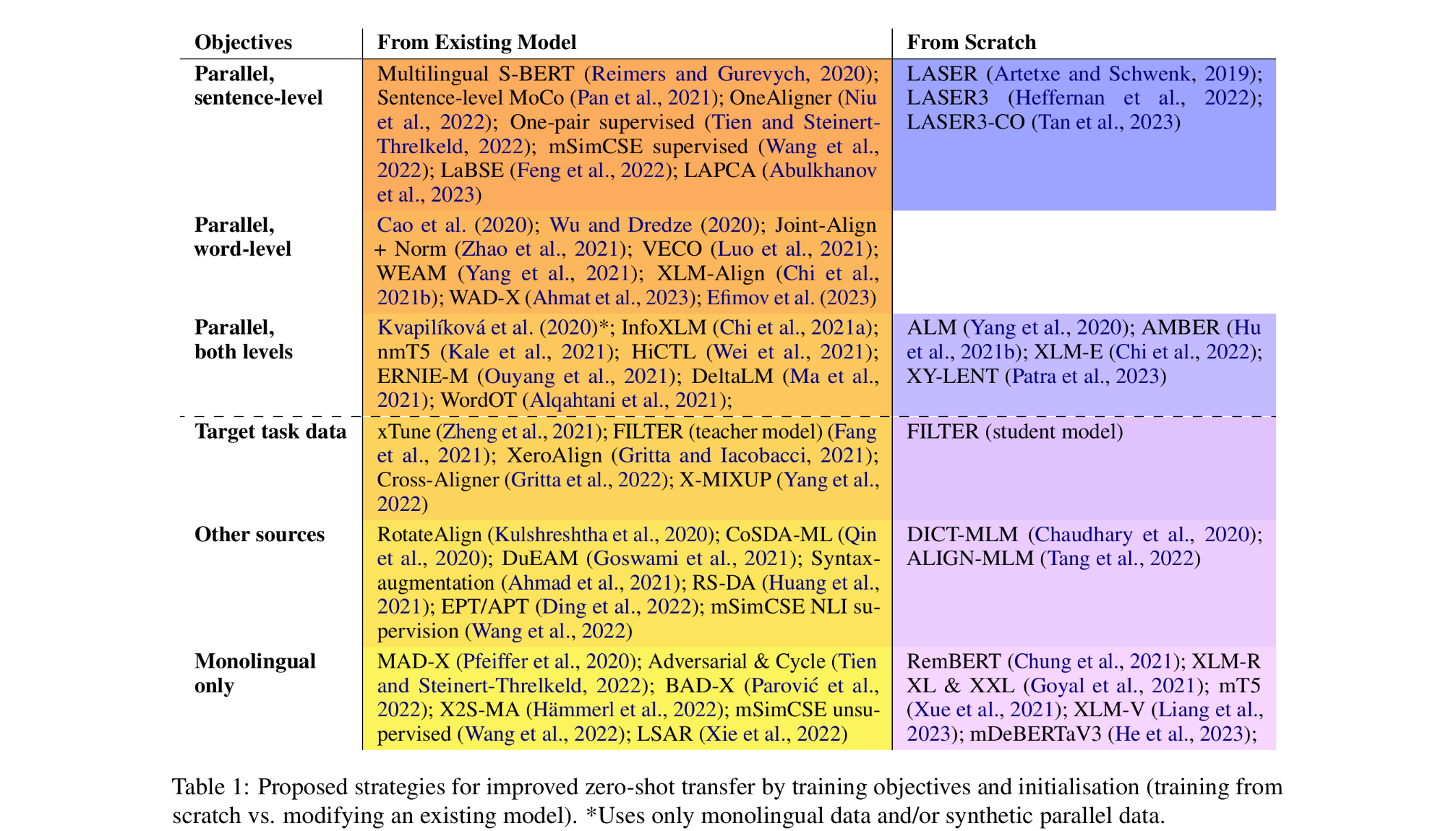 Understanding Cross-Lingual Alignment—A SurveyKathy Hämmerl, Jindřich Libovický, and Alexander FraserIn Findings of the Association for Computational Linguistics: ACL 2024, Aug 2024
Cross-lingual alignment, the meaningful similarity of representations across languages in multilingual language models, has been an active field of research in recent years. We survey the literature of techniques to improve cross-lingual alignment, providing a taxonomy of methods and summarising insights from throughout the field. We present different understandings of cross-lingual alignment and their limitations. We provide a qualitative summary of results from a number of surveyed papers. Finally, we discuss how these insights may be applied not only to encoder models, where this topic has been heavily studied, but also to encoder-decoder or even decoder-only models, and argue that an effective trade-off between language-neutral and language-specific information is key.
@inproceedings{hammerl-etal-2024-understanding, title = {Understanding Cross-Lingual {A}lignment{---}{A} Survey}, author = {H{\"a}mmerl, Kathy and Libovick{\'y}, Jind{\v{r}}ich and Fraser, Alexander}, editor = {Ku, Lun-Wei and Martins, Andre and Srikumar, Vivek}, booktitle = {Findings of the Association for Computational Linguistics: ACL 2024}, month = aug, year = {2024}, address = {Bangkok, Thailand}, publisher = {Association for Computational Linguistics}, url = {https://aclanthology.org/2024.findings-acl.649/}, doi = {10.18653/v1/2024.findings-acl.649}, pages = {10922--10943}, } -
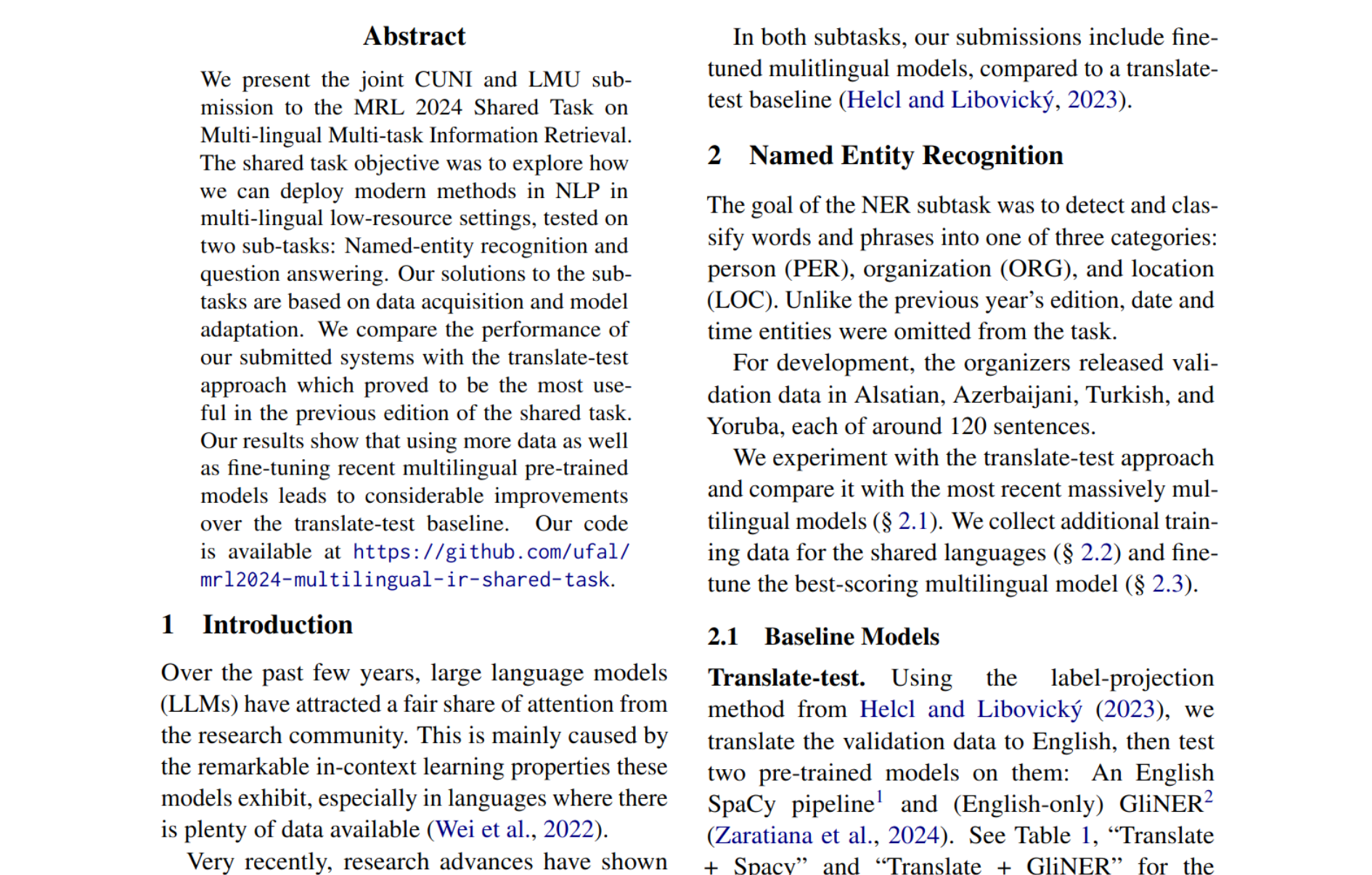 CUNI and LMU Submission to the MRL 2024 Shared Task on Multi-lingual Multi-task Information RetrievalIn Proceedings of the Fourth Workshop on Multilingual Representation Learning (MRL 2024), Nov 2024
We present the joint CUNI and LMU submission to the MRL 2024 Shared Task on Multi-lingual Multi-task Information Retrieval.The shared task objective was to explore how we can deploy modern methods in NLP in multi-lingual low-resource settings, tested on two sub-tasks: Named-entity recognition and question answering.Our solutions to the subtasks are based on data acquisition and model adaptation.We compare the performance of our submitted systems with the translate-test approachwhich proved to be the most useful in the previous edition of the shared task.Our results show that using more data as well as fine-tuning recent multilingual pre-trained models leads to considerable improvements over the translate-test baseline.Our code is available at https://github.com/ufal/mrl2024-multilingual-ir-shared-task.
@inproceedings{hammerl-etal-2024-cuni,
  title = {{CUNI} and {LMU} Submission to the {MRL} 2024 Shared Task on Multi-lingual Multi-task Information Retrieval},
  author = {H{\"a}mmerl, Kathy and Manea, Andrei-Alexandru and Vico, Gianluca and Helcl, Jind{\v{r}}ich and Libovick{\'y}, Jind{\v{r}}ich},
  editor = {S{\"a}lev{\"a}, Jonne and Owodunni, Abraham},
  booktitle = {Proceedings of the Fourth Workshop on Multilingual Representation Learning (MRL 2024)},
  month = nov,
  year = {2024},
  address = {Miami, Florida, USA},
  publisher = {Association for Computational Linguistics},
  url = {https://aclanthology.org/2024.mrl-1.29/},
  doi = {10.18653/v1/2024.mrl-1.29},
  pages = {357--364},
}
2023
-
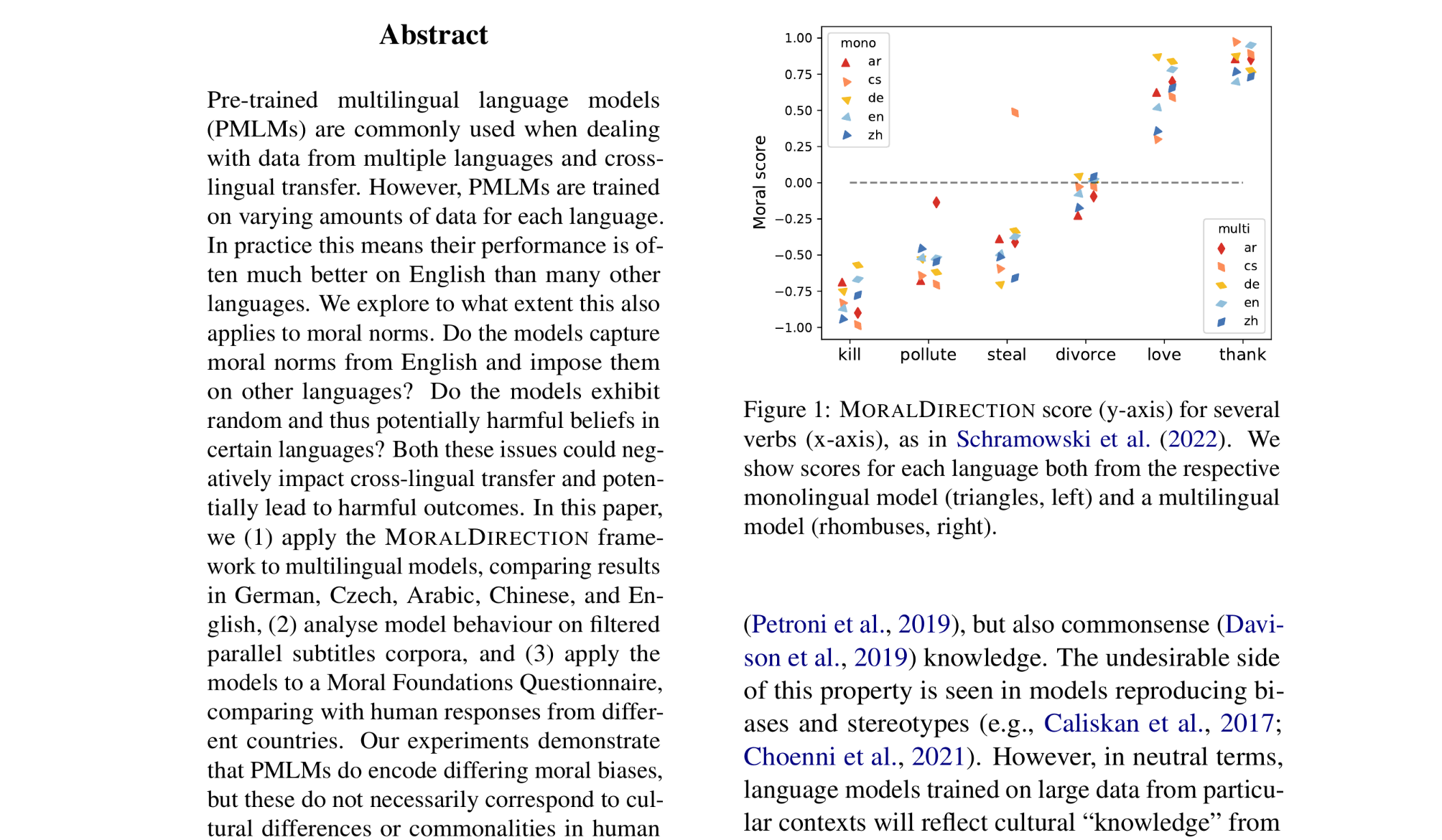 Speaking Multiple Languages Affects the Moral Bias of Language ModelsKathy Hämmerl, Bjoern Deiseroth, Patrick Schramowski, Jindřich Libovický, Constantin Rothkopf, Alexander Fraser, and Kristian KerstingIn Findings of the Association for Computational Linguistics: ACL 2023, Jul 2023
Pre-trained multilingual language models (PMLMs) are commonly used when dealing with data from multiple languages and cross-lingual transfer. However, PMLMs are trained on varying amounts of data for each language. In practice this means their performance is often much better on English than many other languages. We explore to what extent this also applies to moral norms. Do the models capture moral norms from English and impose them on other languages? Do the models exhibit random and thus potentially harmful beliefs in certain languages? Both these issues could negatively impact cross-lingual transfer and potentially lead to harmful outcomes. In this paper, we (1) apply the MORALDIRECTION framework to multilingual models, comparing results in German, Czech, Arabic, Chinese, and English, (2) analyse model behaviour on filtered parallel subtitles corpora, and (3) apply the models to a Moral Foundations Questionnaire, comparing with human responses from different countries. Our experiments demonstrate that, indeed, PMLMs encode differing moral biases, but these do not necessarily correspond to cultural differences or commonalities in human opinions. We release our code and models.
@inproceedings{haemmerl-etal-2023-speaking, title = {Speaking Multiple Languages Affects the Moral Bias of Language Models}, author = {H{\"a}mmerl, Kathy and Deiseroth, Bjoern and Schramowski, Patrick and Libovick{\'y}, Jind{\v{r}}ich and Rothkopf, Constantin and Fraser, Alexander and Kersting, Kristian}, editor = {Rogers, Anna and Boyd-Graber, Jordan and Okazaki, Naoaki}, booktitle = {Findings of the Association for Computational Linguistics: ACL 2023}, month = jul, year = {2023}, address = {Toronto, Canada}, publisher = {Association for Computational Linguistics}, url = {https://aclanthology.org/2023.findings-acl.134}, doi = {10.18653/v1/2023.findings-acl.134}, pages = {2137--2156}, } -
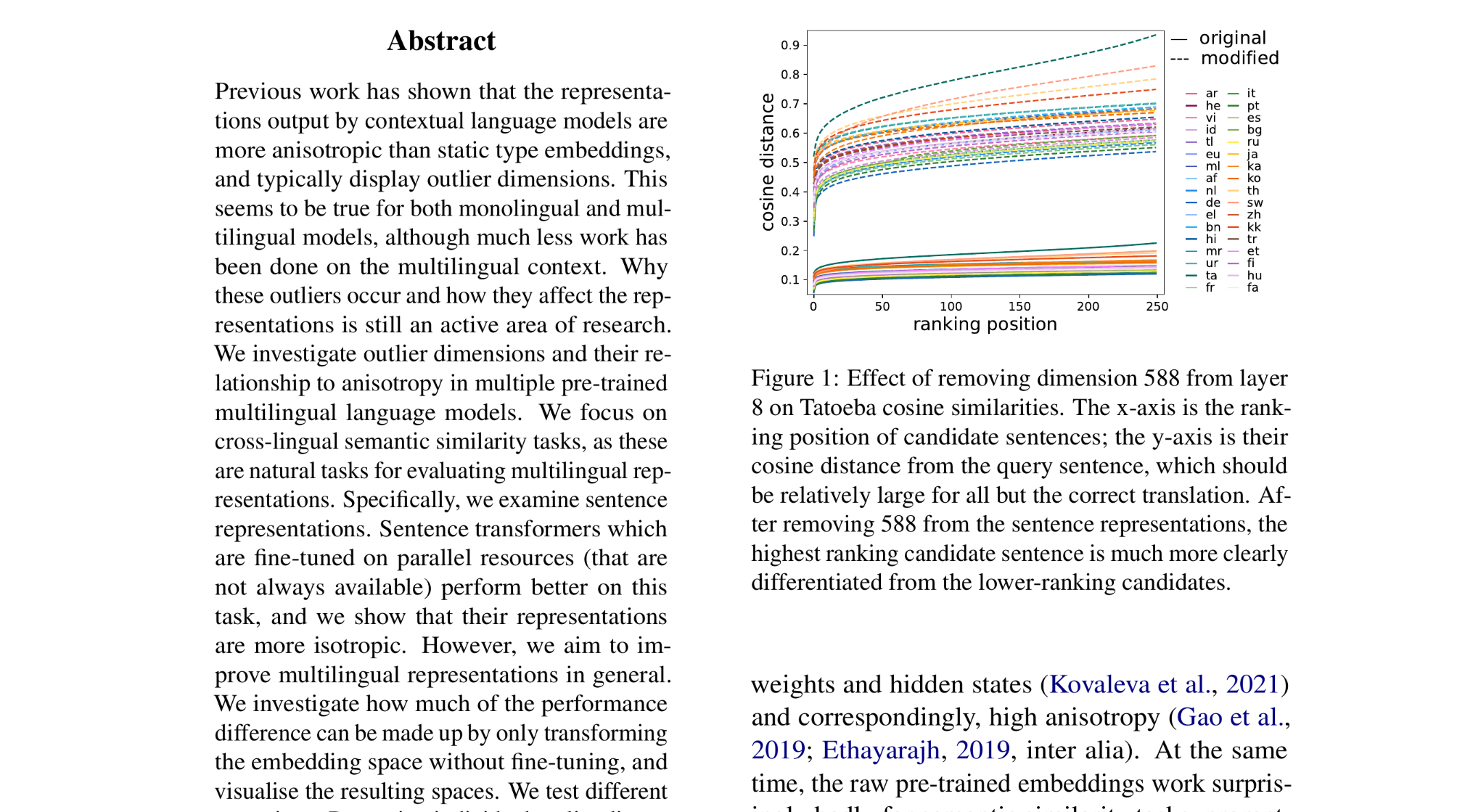 Exploring Anisotropy and Outliers in Multilingual Language Models for Cross-Lingual Semantic Sentence SimilarityIn Findings of the Association for Computational Linguistics: ACL 2023, Jul 2023
Previous work has shown that the representations output by contextual language models are more anisotropic than static type embeddings, and typically display outlier dimensions. This seems to be true for both monolingual and multilingual models, although much less work has been done on the multilingual context. Why these outliers occur and how they affect the representations is still an active area of research. We investigate outlier dimensions and their relationship to anisotropy in multiple pre-trained multilingual language models. We focus on cross-lingual semantic similarity tasks, as these are natural tasks for evaluating multilingual representations. Specifically, we examine sentence representations. Sentence transformers which are fine-tuned on parallel resources (that are not always available) perform better on this task, and we show that their representations are more isotropic. However, we aim to improve multilingual representations in general. We investigate how much of the performance difference can be made up by only transforming the embedding space without fine-tuning, and visualise the resulting spaces. We test different operations: Removing individual outlier dimensions, cluster-based isotropy enhancement, and ZCA whitening. We publish our code for reproducibility.
@inproceedings{haemmerl-etal-2023-exploring, title = {Exploring Anisotropy and Outliers in Multilingual Language Models for Cross-Lingual Semantic Sentence Similarity}, author = {H{\"a}mmerl, Kathy and Fastowski, Alina and Libovick{\'y}, Jind{\v{r}}ich and Fraser, Alexander}, editor = {Rogers, Anna and Boyd-Graber, Jordan and Okazaki, Naoaki}, booktitle = {Findings of the Association for Computational Linguistics: ACL 2023}, month = jul, year = {2023}, address = {Toronto, Canada}, publisher = {Association for Computational Linguistics}, url = {https://aclanthology.org/2023.findings-acl.439}, doi = {10.18653/v1/2023.findings-acl.439}, pages = {7023--7037}, } -
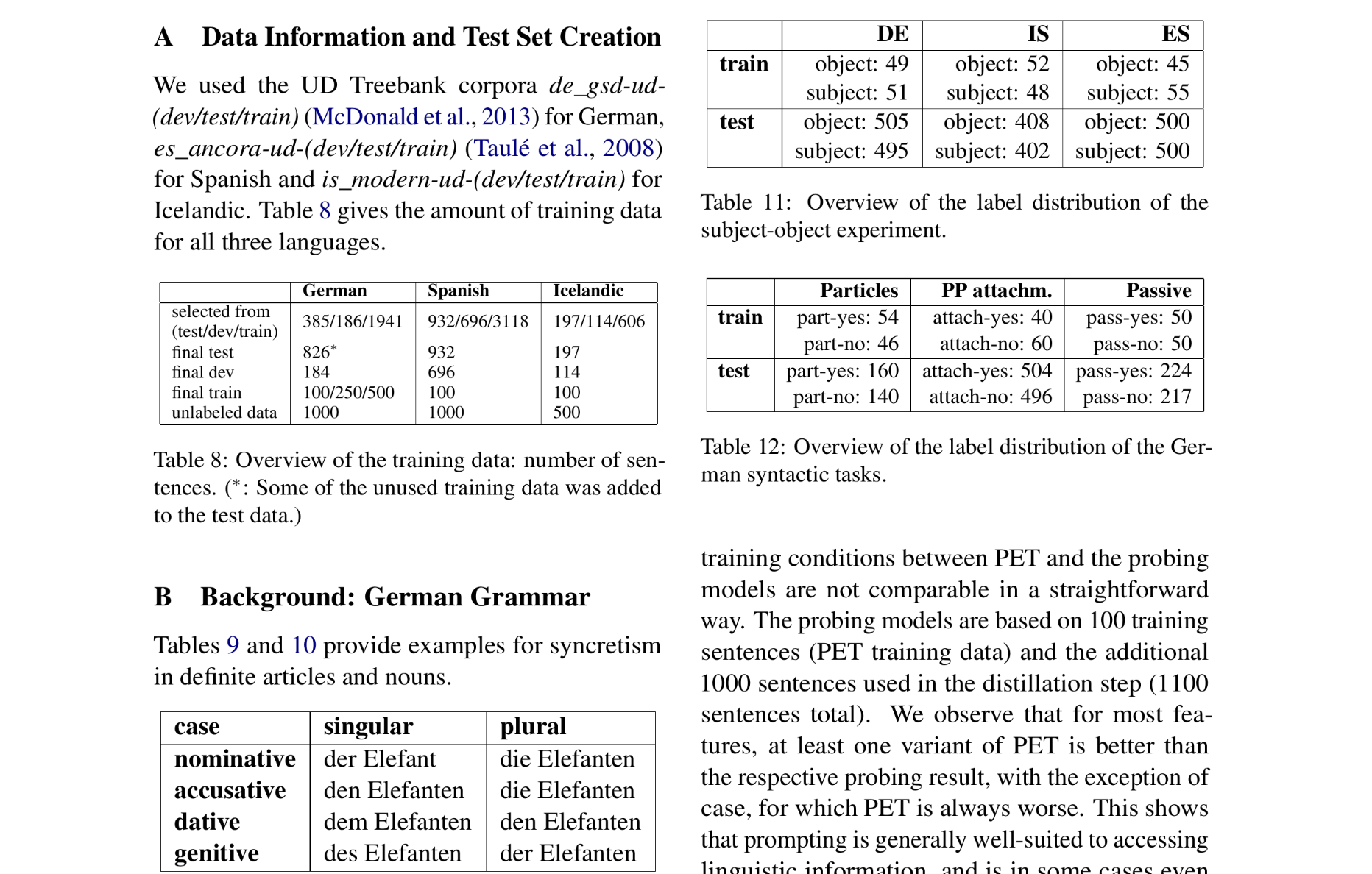 A Study on Accessing Linguistic Information in Pre-Trained Language Models by Using PromptsMarion Di Marco, Kathy Hämmerl, and Alexander FraserIn Proceedings of the 2023 Conference on Empirical Methods in Natural Language Processing, Dec 2023
We study whether linguistic information in pre-trained multilingual language models can be accessed by human language: So far, there is no easy method to directly obtain linguistic information and gain insights into the linguistic principles encoded in such models. We use the technique of prompting and formulate linguistic tasks to test the LM’s access to explicit grammatical principles and study how effective this method is at providing access to linguistic features. Our experiments on German, Icelandic and Spanish show that some linguistic properties can in fact be accessed through prompting, whereas others are harder to capture.
@inproceedings{di-marco-etal-2023-study,
  title = {A Study on Accessing Linguistic Information in Pre-Trained Language Models by Using Prompts},
  author = {Di Marco, Marion and H{\"a}mmerl, Kathy and Fraser, Alexander},
  editor = {Bouamor, Houda and Pino, Juan and Bali, Kalika},
  booktitle = {Proceedings of the 2023 Conference on Empirical Methods in Natural Language Processing},
  month = dec,
  year = {2023},
  address = {Singapore},
  publisher = {Association for Computational Linguistics},
  url = {https://aclanthology.org/2023.emnlp-main.454},
  doi = {10.18653/v1/2023.emnlp-main.454},
  pages = {7328--7336},
}
2022
-
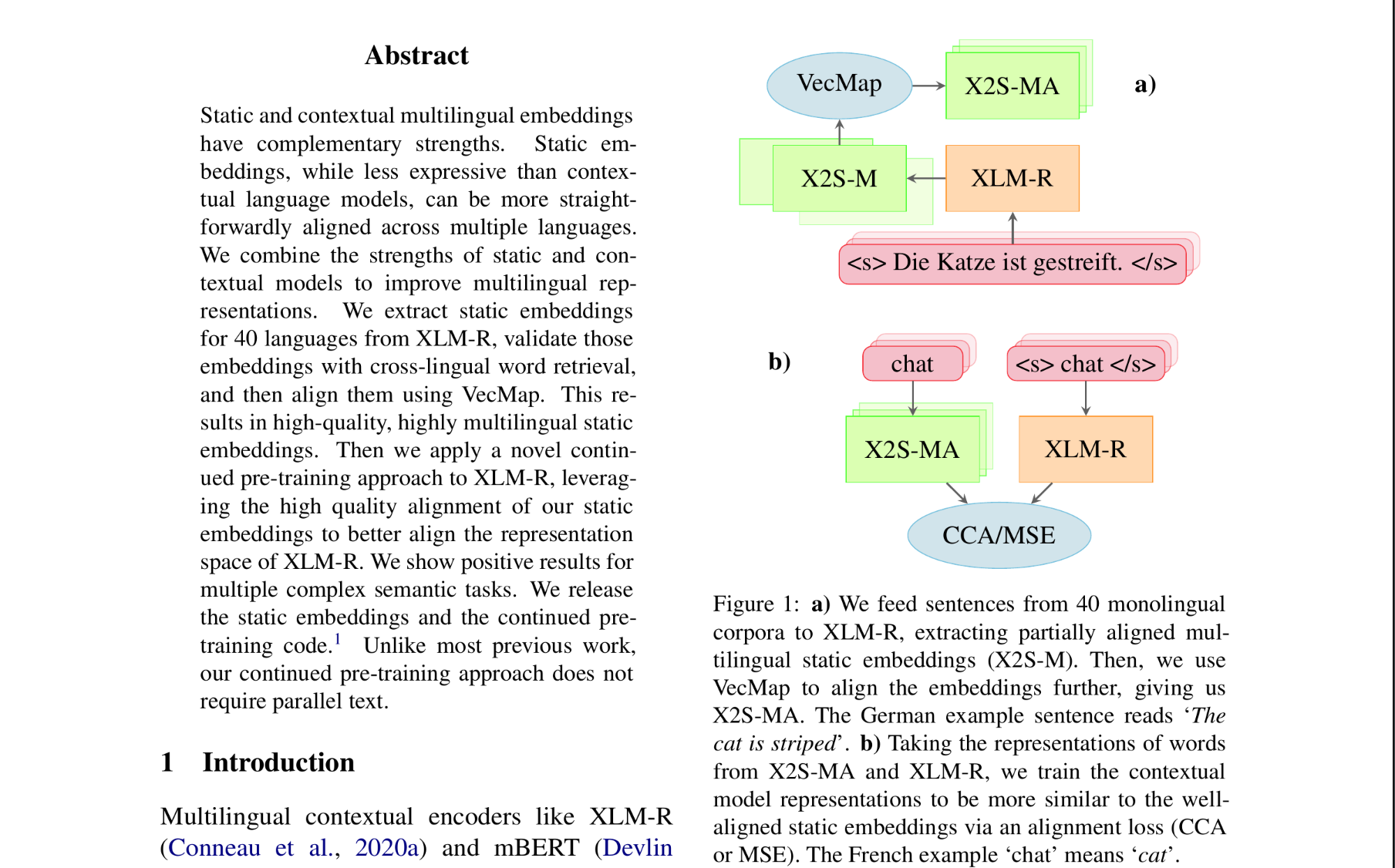 Combining Static and Contextualised Multilingual EmbeddingsKathy Hämmerl, Jindřich Libovický, and Alexander FraserIn Findings of the Association for Computational Linguistics: ACL 2022, May 2022
Static and contextual multilingual embeddings have complementary strengths. Static embeddings, while less expressive than contextual language models, can be more straightforwardly aligned across multiple languages. We combine the strengths of static and contextual models to improve multilingual representations. We extract static embeddings for 40 languages from XLM-R, validate those embeddings with cross-lingual word retrieval, and then align them using VecMap. This results in high-quality, highly multilingual static embeddings. Then we apply a novel continued pre-training approach to XLM-R, leveraging the high quality alignment of our static embeddings to better align the representation space of XLM-R. We show positive results for multiple complex semantic tasks. We release the static embeddings and the continued pre-training code. Unlike most previous work, our continued pre-training approach does not require parallel text.
@inproceedings{hammerl-etal-2022-combining,
  title = {Combining Static and Contextualised Multilingual Embeddings},
  author = {H{\"a}mmerl, Kathy and Libovick{\'y}, Jind{\v{r}}ich and Fraser, Alexander},
  editor = {Muresan, Smaranda and Nakov, Preslav and Villavicencio, Aline},
  booktitle = {Findings of the Association for Computational Linguistics: ACL 2022},
  month = may,
  year = {2022},
  address = {Dublin, Ireland},
  publisher = {Association for Computational Linguistics},
  url = {https://aclanthology.org/2022.findings-acl.182},
  doi = {10.18653/v1/2022.findings-acl.182},
  pages = {2316--2329},
}